

How To Repair Drywall Tape On Textured Ceiling
To repair loose drywall record on a textured ceiling, first, use a utility knife to cut away the loose section of record. And so, sand the surface area where the record was installed, existence careful not to damage the drywall beneath. One time the area is prepared, install new record and keep information technology in place with ii–3 coats of joint compound. After the last coat of joint compound has hardened, sand the area. Finally, reapply texture to the surface area using a spray texture or by applying joint compound with a texture sponge.

Why Does Drywall Tape Come Loose From a Ceiling?
Drywall tape may start to peel off due to natural factors, such as air humidity or your business firm settling over time. All the same, excess moisture from a roof leak may exist the crusade. If drywall tape has begun to peel off your ceiling, take a closer wait. If in that location are yellowish or chocolate-brown water stains on your drywall ceiling, or if the layer of drywall is misshapen and moist, this may be evidence of a roof leak.
- Nigh peeling drywall record is caused by humidity or a firm settling.
- In some cases, a roof leak may be the cause of peeling drywall record.
- Inspect your ceiling for h2o stains when removing and replacing drywall tape, to decide if at that place is a roof leak.
If your roof is leaking, repairing drywall tape will but exist a temporary fix. The water introduced by a roof leak volition ruin your repairs and contribute to long-term damage. If you take a roof leak, contact a professional for repairs.
seven Steps to Set up Drywall Tape on a Textured Ceiling
Repairing drywall tape on a textured ceiling may seem like a daunting job. After all, how are you going to be able to make a seamless prepare that matches the surrounding ceiling? Don't fear. With the right tools and techniques, yous can brand a long-lasting drywall repair and texture your ceiling to match the surface area around your piece of work.
Assemble Your Tools
Getting the chore right requires the right tools. When fixing loose drywall tape on a textured ceiling, you volition need the following:
- Ladder
- Drop cloth
- Protective goggles, gloves, and a dust mask
- Utility pocketknife
- Sandpaper, in 120, 150, and 220 grit
- Drywall tape (either paper tape or mesh)
- three-inch putty knife
- Joint compound, also known every bit drywall mud
- Spray-on ceiling texture OR a texturing sponge
With these simple tools and materials, you can repair your ceiling yourself. Simply follow the steps below to complete the repair job.
Remove Loose Tape
Using your ladder to reach the ceiling, cutting abroad the loose tape with your utility knife. Cut the loose tape back to a point where it is solidly attached to the ceiling, leaving no loose ends.
- Cut away the loose section of tape with a utility knife.
- Remove the entire loose section without damaging the drywall beneath.
- Practise not attempt to repair loose drywall tape by adding joint compound nether the loose tape and pressing it back into place.
Removing damaged or loose record is much more effective than attempting to apply joint compound under the loose tape and sticking information technology back into place. Trying to putty loose tape results in lumpy, uneven drywall seams that adhere poorly. Record repaired in this style is likely to come loose again.
Sand the Expanse
After removing the loose tape, sand the drywall seam where the tape came loose. Apply 120 grit sandpaper to initially sand the area, followed by 150 grit to smooth it. Brand sure non to sand through the newspaper roofing of the drywall. The goal here is to remove any former joint compound on the drywall seam to create a make clean surface for repairs.
- Employ 120 grit sandpaper or this sanding block to sand the surface area where the tape was removed.
- Sand away any remainder joint chemical compound without sanding through the paper covering on the drywall.
- It's expected for some ceiling texture to be removed during this process.
- Wear heart protection, gloves, and a dust-filtering mask whenever y'all are sanding drywall or joint chemical compound.
Don't worry if some of the ceiling texture effectually the seam is removed during the sanding procedure. We volition repair and friction match the texture of the ceiling in one case the repair has been completed.
Install New Tape
For the simplest results re-taping the seam, use self-adhesive mesh drywall tape. Tape over the exposed seam, making certain not to overlap the new tape with existing record at either end of the repair area. Information technology's okay to accept upwardly to a 1 inch (ii.5 cm) gap in between the end of the existing tape and the beginning of the new tape.
- Use this mesh drywall record to make taping the joint easier.
- Record the exposed seam without allowing the new tape to overlap the existing tape.
- Use your putty knife to spread articulation chemical compound over the tape to achieve a smoothen surface.
Once the tape is in place, spread a layer of articulation compound over the record. Work to achieve a smooth surface that blends the taped area seamlessly with the sanded expanse around it. Brainstorm with a thin layer of joint compound.
Use Multiple Coats of Joint Compound
The best way to repair drywall seams is to work in increments. Don't effort to repair the seam flawlessly with one coat of joint compound. Instead, utilize a glaze of articulation compound and wait 24 hours. Once 24 hours have passed, sand the joint compound with 150 grit sandpaper and apply some other coat. You may need to repeat this process 2–iii times to get a smooth seam.
- Lay a drop material on the floor beneath whenever you are applying joint compound.
- Utilize ii–3 coats of joint chemical compound, building up the repair patch in increments.
- Wait 24 hours betwixt coats, to permit it to dry.
- Sand the area lightly with 150 grit sandpaper between coats, to prevent buildup and imperfections that crave heavy sanding.
By applying joint compound a piddling at a time and sanding between coats, y'all build a smooth surface that blends with the surrounding ceiling. This makes the difference betwixt a poor repair and a flawless i.
Sand Articulation Chemical compound
In one case yous've completed your final coat of articulation chemical compound, wait at to the lowest degree 24 hours earlier sanding. When you do sand, brainstorm with 120 grit sandpaper to remove whatsoever bumps or ridges, followed by 150 grit to shine the edges, and finishing with 220 dust to make a perfectly blended surface.
- Look 24 hours after your terminal coat of joint compound earlier sanding.
- Get-go, sand with 120 dust sandpaper to remove ridges and large imperfections in the joint compound.
- Smoothen any grooves or gouges left by 120 grit sandpaper by using 150 grit.
- Make a perfect final terminate with 220 grit sandpaper.
In one case you've completed this process, you lot will be left with a professional, smooth end. This taped and floated seam will hold up for a long time to come. Your ceiling is at present fully patched and ready for texturing.
Add together Texture
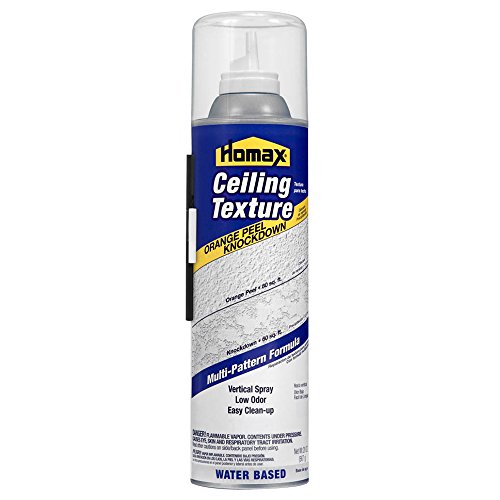
To repair a textured ceiling, there are 2 easy options for the dwelling house DIYer. First, you can apply a spray product to rapidly add texture to a portion of your ceiling. Alternatively, you can use a texturing sponge to apply joint chemical compound or a special texture patch product to the ceiling to create a textured look.
- This spray texture can exist used to add texture to the ceiling later patching.
- Alternatively, y'all can utilise this texturing sponge to add together texture to your ceiling.
- Dip i side of the texturing sponge in articulation compound or a specialized texture patch product and dab it on the ceiling to recreate the surrounding texture.
- Utilise a driblet cloth whenever y'all are adding texture to a ceiling.
We earn a commission if you click this link and make a purchase at no additional cost to y'all.
Adding ceiling texture with a sponge takes some trial and error. It's a proficient thought to exam it out on a piece of paper-thin before moving on to your ceiling. Experiment with dabbing texture on the cardboard with the sponge and using your putty pocketknife to lightly scrape abroad excess. Information technology's often a skilful idea to wait 15–20 minutes later applying the texture to scrape abroad the excess, every bit the product will be semi-hardened at this point.

Nosotros earn a commission if you click this link and make a buy at no boosted price to you.
How Do You Repair Drywall Tape on a Textured Ceiling?
If a portion of tape on your textured ceiling comes loose, y'all can repair it yourself. Here'southward how:
- Cut away the loose portion of the record.
- Sand the area to remove joint compound and texture in the surrounding area.
- Apply new drywall tape and cover it with a coat of joint compound.
- Utilise additional coats of articulation compound every bit needed to attain a seamless repair. Wait 24 hours between coats.
- Sand the repaired seam in your ceiling until it blends with the drywall on either side.
- Use spray texture or a texturing sponge to repair the texture on your ceiling.
It really is that simple. With a few tools and elementary steps, you can repair popcorn ceilings and lucifer whatever ceiling texture. All that'south left from there is to apply a fresh coat of paint to match the surrounding ceiling.
Source: https://peppershomeandgarden.com/fix-drywall-tape-textured-ceiling/
0 Response to "How To Repair Drywall Tape On Textured Ceiling"
Post a Comment